Large public organizations face a structural paradox: they carry the operational weight of decades-old processes while being expected to compete with the agility of digital-native enterprises. For enterprise transformation leads, the challenge is not simply adopting new technology — it is building a coherent, measurable framework that connects strategic vision to day-to-day execution. The question is not whether to transform, but how to measure where you stand and chart a credible path forward.
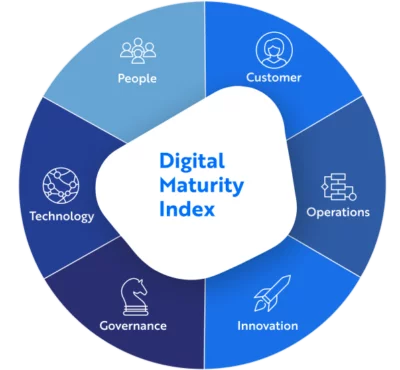
This is precisely where a structured Digital Maturity Index (DMI) becomes indispensable. Rather than relying on anecdotal assessments or siloed technology audits, the DMI provides a realistic snapshot of an organization’s current capabilities across three core pillars: Strategic Vision, Collaborative Work, and Digital Tools [Source 7]. When applied to large public-sector or quasi-public organizations, this framework transforms abstract transformation goals into actionable, trackable milestones.
Grupo Correos offers one of the most instructive examples of this kind of structured transformation in the Spanish public enterprise landscape. In 2012, the group defined a new business strategy whose directives were crystallized in the Action Plan 100-300-1500 — a roadmap that has enabled the group to adapt with greater agility to changes in the competitive environment and in customer demands, while delivering maximum quality of service and ensuring future sustainability [Source 10]. Unpacking how that plan was structured reveals a blueprint that enterprise transformation leads can apply directly through the DMI lens.
The 100-300-1500 Action Plan: A Structured Transformation Roadmap
Five Strategic Lines, Seven Action Axes
The transformation of Grupo Correos driven by the Action Plan is organized around five strategic lines, which are in turn supported by seven action axes — within which all actions carried out by the group’s companies across their various business lines are framed [Source 10]. This architecture is significant: it demonstrates that large-scale transformation is not a single initiative but a layered system of priorities, each reinforcing the others.
The five strategic lines identified in the plan are: operational optimization, increase in commercial effectiveness, innovation, development of the organizational model, and diversification [Source 8][Source 9]. Each of these maps directly onto the kind of capability domains that a DMI assessment evaluates. Operational optimization corresponds to the Digital Tools pillar — how effectively current systems reduce friction and increase throughput. Innovation and organizational model development correspond to the Strategic Vision pillar — the degree to which leadership has a coherent, forward-looking digital agenda. Commercial effectiveness and diversification speak to the Collaborative Work pillar — how well cross-functional teams align around shared digital objectives [Source 7].
Governance as a Transformation Enabler
One of the most underappreciated elements of the Correos model is its governance structure. The Group’s Strategy Committee is responsible for establishing priority measures, reviewing and defining lines of action, and planning the necessary resources. The Transformation Projects Office functions as a cross-cutting unit across the entire group, made up of multidisciplinary teams that coordinate, support, and facilitate the execution of actions [Source 10].
This governance design — a central strategy committee paired with a transversal execution office — is a model that the DMI framework explicitly recognizes as a marker of advanced digital maturity. Organizations that score highly on the Strategic Vision pillar consistently demonstrate this separation between strategic oversight and operational execution, preventing transformation from becoming either too top-down or too fragmented [Source 7].
Why the DMI Framework Is the Right Measurement Standard
Defining Digital Maturity: A Precise, Actionable Concept
Digital maturity is not a vague aspiration. In the DMI framework, it is defined as the degree to which an organization has aligned its Strategic Vision, Collaborative Work practices, and Digital Tools deployment to enable adaptive, data-informed decision-making [Source 7]. This three-pillar structure is what distinguishes the DMI from generic digital readiness surveys: it does not simply ask whether an organization uses digital tools, but whether those tools are embedded in a coherent strategic and collaborative context.
For public administration and large quasi-public enterprises like Grupo Correos, this distinction is critical. Many such organizations have invested heavily in individual digital tools — enterprise resource planning systems, customer portals, data warehouses — without achieving the strategic alignment that converts those investments into measurable performance gains. The DMI surfaces exactly this gap.
The Three Pillars in Practice
Strategic Vision measures whether leadership has a documented, communicated, and resourced digital agenda. In the Correos case, the 100-300-1500 Action Plan itself is evidence of Strategic Vision maturity: it is a named, structured roadmap with defined objectives, governance mechanisms, and resource planning [Source 10]. Organizations that lack this level of formalization consistently score in the lower quartiles of DMI assessments.
Collaborative Work evaluates how to measure organizational digital transformation using the DMI framework by looking at how effectively cross-functional teams operate around shared digital objectives. The Transformation Projects Office at Correos — composed of multidisciplinary teams that coordinate and facilitate execution across the entire group — is a textbook example of high Collaborative Work maturity [Source 10]. It is not enough to have a digital strategy; execution requires teams that can operate across organizational silos.
Digital Tools assesses the depth and integration of the technology stack. In the public sector context, the sources note that it is foreseeable that the public sector will lean toward contracting integrated telecommunications solutions, making it essential to achieve alliances and synergies with other companies in the sector for the provision of these services [Source 8][Source 9]. This points to a mature understanding of Digital Tools maturity: it is not about owning every capability internally, but about building an ecosystem of integrated solutions.
Applying the DMI to Public Administration: Key Lessons
Start with a Realistic Baseline, Not an Aspirational Target
The most common mistake enterprise transformation leads make is benchmarking against best-in-class digital natives rather than establishing an honest baseline of current capabilities. The DMI is explicitly designed to provide a realistic snapshot — not a flattering one [Source 7]. For public administration organizations, this means acknowledging legacy infrastructure constraints, procurement cycle limitations, and workforce digital literacy gaps before defining transformation targets.
The Correos model is instructive here. The 100-300-1500 plan was defined in 2012 as a response to a specific competitive and regulatory context — including the development of the Commission for the Reform of Public Administrations (CORA) and the anticipated shift toward integrated telecommunications contracting [Source 1][Source 8]. The plan did not pretend the organization was starting from a position of digital strength; it mapped a path from the actual current state to a defined future state.
Align Transformation Lines to DMI Pillars Before Launching Initiatives
A critical lesson from the Correos transformation architecture is the value of mapping strategic lines to capability pillars before launching individual initiatives. The five strategic lines of the 100-300-1500 plan — operational optimization, commercial effectiveness, innovation, organizational model development, and diversification — each correspond to distinct capability domains [Source 8][Source 9]. This prevents the common failure mode where organizations launch dozens of disconnected digital projects that collectively fail to move the maturity needle.
For enterprise transformation leads applying the DMI, the practical implication is clear: before approving any digital initiative, map it explicitly to one of the three DMI pillars. If an initiative cannot be clearly assigned to Strategic Vision, Collaborative Work, or Digital Tools, it is either redundant or misaligned [Source 7].
Build Transversal Execution Capacity
The Transformation Projects Office model at Correos — a cross-cutting unit with multidisciplinary teams that coordinate, support, and facilitate execution — addresses one of the most persistent failure modes in large-scale digital transformation: the gap between strategy formulation and operational execution [Source 10]. In public administration, this gap is often institutionalized through rigid departmental structures and annual budget cycles that do not align with the iterative pace of digital change.
The DMI framework’s Collaborative Work pillar specifically focuses on assessing collaborative work readiness in your digital maturity journey to evaluate whether organizations have built this kind of transversal execution capacity. High-scoring organizations do not rely on individual departments to self-manage digital transformation; they create dedicated coordination structures that operate across the entire organization [Source 7].
From Assessment to Action: Implementing the DMI in Your Organization
Translating a DMI assessment into a transformation roadmap requires a structured sequence. Based on the Correos model and the DMI framework’s three-pillar architecture, enterprise transformation leads should follow this implementation path:
-
Conduct a baseline DMI assessment across all three pillars — Strategic Vision, Collaborative Work, and Digital Tools — using structured interviews, process audits, and technology stack reviews [Source 7].
-
Map existing initiatives to the five strategic transformation lines: operational optimization, commercial effectiveness, innovation, organizational model development, and diversification [Source 8][Source 9]. Identify gaps where no current initiative addresses a strategic line.
-
Establish a governance structure that separates strategic oversight (equivalent to the Strategy Committee function) from transversal execution (equivalent to the Transformation Projects Office function) [Source 10].
-
Define a named, documented action plan — analogous to the 100-300-1500 plan — that gives the transformation a concrete identity, measurable milestones, and a resource allocation framework [Source 10].
-
Reassess DMI scores at defined intervals to track progress across all three pillars and adjust priorities based on where maturity gains are lagging.
-
Build ecosystem alliances for Digital Tools capabilities that cannot be developed internally, particularly in integrated telecommunications and data infrastructure [Source 8][Source 9].
The DMI as the Standard for Enterprise Transformation Measurement
The Grupo Correos 100-300-1500 Action Plan is not simply a historical case study — it is a proof of concept for the kind of structured, multi-pillar transformation architecture that the DMI framework is designed to measure and guide. The plan’s five strategic lines, seven action axes, dual governance structure, and explicit focus on agility, quality, and sustainability map precisely onto the Strategic Vision, Collaborative Work, and Digital Tools pillars that define digital maturity [Source 8][Source 9][Source 10].
For enterprise transformation leads in public administration, the takeaway is unambiguous: transformation without measurement is reorganization without direction. The DMI provides the measurement standard that converts strategic intent into trackable progress — and the Correos model demonstrates what that looks like at scale.
If your organization is preparing to launch or recalibrate a digital transformation program, the first step is an honest DMI baseline assessment. Wayland’s Digital Maturity Index framework is built specifically for this purpose — to give enterprise leaders the realistic, pillar-by-pillar diagnostic they need to build a transformation roadmap that holds. Reach out to our team to schedule a DMI assessment and begin mapping your organization’s path from current state to digital leadership.
—SEO-METADATA—
URL_SLUG: dmi-framework-public-administration-digital-transformation
SEO_TITLE: DMI Framework for Public Administration Digital Transformation
META_DESCRIPTION: Learn how Grupo Correos’ 100-300-1500 Action Plan maps to Wayland’s Digital Maturity Index — a proven framework for measuring enterprise digital transformation.
—END-SEO-METADATA—